
Ancient Rome in One Day: Colosseum, Roman Forum & Palatine Hill Itinerary
Yes, you can visit Ancient Rome in one day. The best order is the Colosseum first, then the Roman Forum, and finally Palatine Hill. Use a single 24-hour combined ticket, aim for the first morning slot, between 8:45 and 9 AM, and plan 5 to 7 hours total. A condensed 4-hour version is possible if you skip most SUPER sites and the Palatine Museum. Book several weeks ahead, especially April through October.
This sequence turns your visit into a historical narrative: the Colosseum shows imperial power as public spectacle, the Roman Forum reveals Rome’s political and religious life, and Palatine Hill closes the day where the founding myth and imperial palaces converge.
Beyond the step-by-step itinerary, this guide covers 2026 tickets, when SUPER sites are worth it, and how to adapt the visit if you only have 4 or 5 hours.
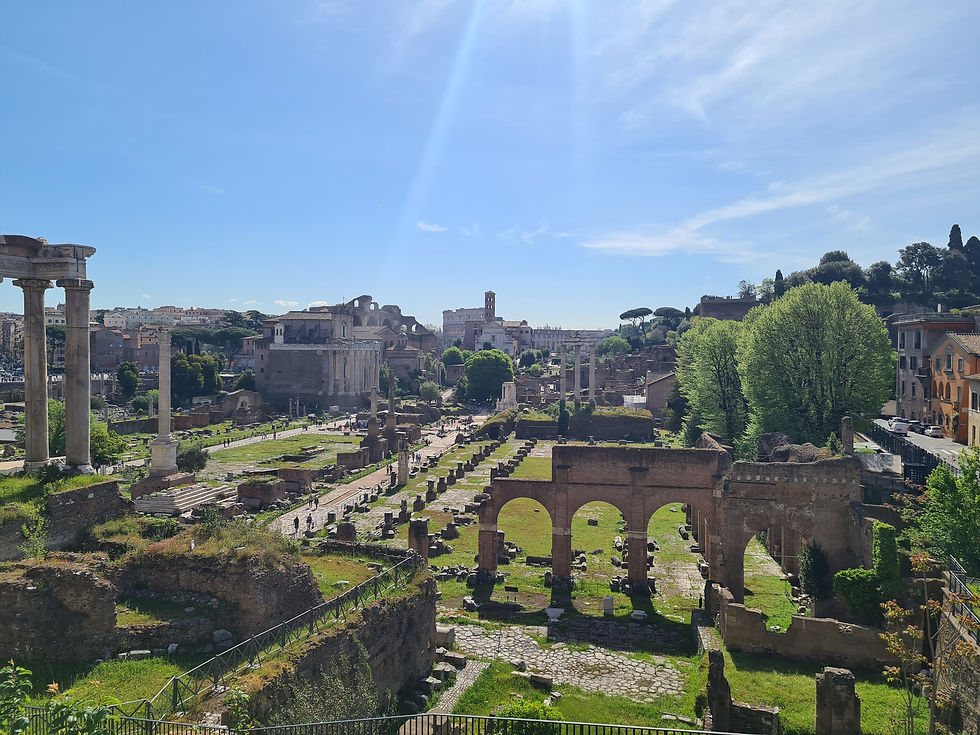
Itinerary at a Glance
Stop | What It Is | Why It Matters |
1. Colosseum | The most recognizable symbol of the Roman Empire | Imperial power transformed into public spectacle |
2. Roman Forum | The political, religious, and commercial center of Rome for centuries | Where the Republic functioned and the Empire took hold |
3. Palatine Hill | The hill where Rome was born according to legend, and where emperors lived | The place where founding myth and imperial power converge |
Total duration: 5 to 7 hours
Best entry time: First available morning slot, generally between 8:45 and 9 AM
Base ticket: €18, covering Colosseum + Roman Forum + Palatine Hill + Imperial Fora, valid for 24 hours
Book when: Several weeks in advance, especially April–October
Where to book: Official Parco Archeologico del Colosseo platform or Viator/GetYourGuide for guided tours
Who This Guide Is ForThis guide is for travelers who want to connect the Colosseum, Roman Forum, and Palatine Hill into one structured day, not three disconnected stops. It is especially useful if you prefer planning your own visit but still want clear 2026 ticket guidance, realistic timing, and both 4-hour and 5-hour options |
Table of Contents
Why This Itinerary Works
Picture arriving at the Colosseum early in the morning, when the amphitheater is still relatively calm. Then, walking down to the Roman Forum, following the Via Sacra, and starting to understand how Rome actually functioned before it became an empire.
Finishing at the top of Palatine Hill, with the Forum spread out below and the Colosseum framed behind you, is one of the best viewpoints in the entire Ancient Rome archaeological area.
All of this is possible in a single day, without turning the experience into an exhausting blur, as long as the route follows a clear logic.
Most itineraries organize the Colosseum, Forum, and Palatine Hill by geographic proximity. This one organizes them by historical narrative: each stop explains the next, and by the end of the day, you understand not just what you saw, but what those places meant to the civilization that built them.
Can You Really Visit All Three Sites in One Day?
Yes, you can visit all three sites in one day, and it works better than most people expect. The Colosseum, Roman Forum, and Palatine Hill are located within easy walking distance, essentially one connected archaeological area.
The challenge is not logistics but pacing. With 5 to 7 hours, you can move through all three sites meaningfully, not just check boxes. With 4 hours, you will see the essential highlights at each stop, but you will likely leave wishing you had more time at the Roman Forum.
That is the site most visitors underestimate and the one that rewards slowness the most.
If you only have half a day, the guide includes a condensed 4-hour version below.
What Tickets to Buy for the Colosseum, Roman Forum & Palatine Hill
Buy tickets through the official Colosseum ticketing platform, linked from the Parco Archeologico del Colosseo website, and reserve in advance, especially between April and October. Showing up at the ticket office on the day is risky: Colosseum time slots sell out regularly, and without a reservation, you may not get in.
If you prefer buying through platforms with English-language support and guided tour options, tickets and tours are also available on Viator and GetYourGuide.
You do not need three separate tickets. The standard Colosseum ticket is a combined ticket that includes the Colosseum, Roman Forum, Palatine Hill, and Imperial Fora.
Ticket Type | Price | What's Included | Best For |
Standard 24h ticket | €18 | Colosseum + Roman Forum + Palatine Hill + Imperial Fora | Most visitors; sufficient for this itinerary |
Arena floor access | €18 | Standard entry + arena floor + Forum + Palatine + Imperial Fora | Anyone who wants to see the amphitheater from a different angle without the underground tour |
Full Experience: underground + arena | €24 | Colosseum, arena floor, underground chambers, Forum, Palatine, Imperial Fora, SUPER sites | Most complete Colosseum experience |
Forum Pass SUPER | €18 | Roman Forum, Palatine Hill, Imperial Fora, SUPER sites, no Colosseum | Second visit focused only on the archaeological area |
Guided tour | Varies by platform | May include standard entry, arena, underground, or specialist guide | When the priority is understanding Ancient Rome without researching everything on your phone |
For most visitors, the €18 standard 24h ticket is enough because it covers the Colosseum, Roman Forum, Palatine Hill, and Imperial Fora. The €24 Full Experience is the better upgrade if you want the underground chambers, arena floor, and SUPER sites. Guided tours cost more, but they can be worth it if you want historical context, especially in the Roman Forum.
On pricing: The standard ticket and the arena floor ticket cost the same, €18, but offer different experiences. The difference is arena floor access, not price. Check the options available on the official site during the week of your visit, as availability may vary.
My recommendation for this itinerary: If this is your first time in Rome, the standard 24-hour ticket covers everything you need. If you enjoy archaeology or want a more memorable experience, the Full Experience with underground and arena access is the most worthwhile upgrade.
Important: Tickets are issued in your name. Bring a valid ID and arrive 15 minutes before your scheduled time slot.
If you are still learning how timed-entry tickets work in Italy, start with my guide on how to buy tickets in advance in Italy before booking the Colosseum.
Do You Need to Book in Advance, and How Do Skip-the-Line Tickets Work?
Book in advance, especially between April and October. Colosseum time slots sell out regularly, and walk-up availability in high season is unreliable. Without a reservation, you may face a long wait or end up with a slot that leaves too little time for the Roman Forum and Palatine Hill.
Skip-the-line tickets do not skip security. They usually mean a reserved entry time and no general ticket-purchase line.
Arrive before your time slot, follow the entrance assigned to your ticket, and check whether your tour includes standard entry, arena access, underground chambers, or all three sites: Colosseum, Roman Forum, and Palatine Hill.
Colosseum vs Roman Forum: Which Should You Prioritize?
If you have to choose, prioritize the Colosseum for impact and the Roman Forum for meaning. The Colosseum is the unforgettable visual icon; the Forum is where the political story of Ancient Rome becomes clearer.
For a first visit, see both. But do not spend so long at the Colosseum that you rush the Roman Forum. Most visitors remember the Colosseum first, but they often understand Ancient Rome better once they have walked the Via Sacra and seen where political, religious, and civic life actually unfolded.
What Can You See for Free from Outside?
You can see the Colosseum exterior, parts of the Imperial Fora, and views from Via dei Fori Imperiali without a ticket. This is useful if you are short on time or want a first look before your scheduled entry.
Paid entry gives you access inside the Colosseum and into the Roman Forum and Palatine Hill archaeological area. If this is your first time in Rome, the combined ticket is worth it. Seeing the ruins from street level gives you scale; walking through them gives you context.
What Are the SUPER Sites and When Are They Worth It?

The SUPER sites are restricted areas within the Roman Forum and Palatine Hill that require a special ticket or supplement to access. While the standard itinerary covers the open-air ruins, the SUPER sites open enclosed spaces that most visitors never see, places where Ancient Rome feels more alive than almost anywhere else in the archaeological area.
What you access with the SUPER supplement:
Site | What It Is | Whe |
House of Augustus | Residence associated with Rome's first emperor on Palatine Hill; first-century BC frescoes among the most impressive in the area | Mondays |
House of Livia | Residence associated with Augustus's wife; first-century BC wall paintings | Tuesdays |
Imperial Ramp | Covered passage connecting Palatine Hill to the Roman Forum; rarely crowded, valuable for understanding how power moved through the city | Varied |
Horrea Piperataria | Ancient spice warehouses on the edge of the Forum | Check official calendar |
Curia Julia | Building associated with the Roman Senate; preserved interior and marble floor | Check official calendar |
When is the SUPER supplement worth it?
The House of Augustus and the House of Livia close on different days, and spaces like the Horrea Piperataria follow their own calendar. The supplement can be one of the most rewarding upgrades in the archaeological area if at least two or three of the main spaces are open on your day visit.
Full Experience | Yes, already included |
Standard / arena | Usually requires a separate supplement or compatible ticket; verify on the official site before buying |
Before you go: In the week of your visit, check the official Parco Archeologico del Colosseo website for the SUPER sites opening calendar, individual closing days, supplement availability, and seasonal hours.
TripnSense tip: If your visit falls on a Monday or Tuesday, check carefully. The House of Augustus and the House of Livia tend to close on different days. The supplement may still be worth it if other special spaces are open, but do not buy it without checking the official calendar first.
What Is the Best Order to Visit: Colosseum, Roman Forum & Palatine Hill?
Most itineraries follow a route based solely on proximity to entrances. This guide takes a different approach: visit Ancient Rome as a narrative of power.
For context, Rome went through three major phases: the Monarchy, the Republic, and the Empire. What makes this route work is that the ruins still reflect that evolution.
Best order to visit:
Colosseum: imperial power as public spectacle
Roman Forum: political and religious heart of Rome and the transition into the age of emperors
Palatine Hill: where Rome’s founding myth and the peak of imperial power
A simple timeline to orient your visit:
Year | Event | Site |
753 BC | Legendary founding of Rome by Romulus | Palatine Hill |
509 BC | Beginning of the Roman Republic | Roman Forum |
27 BC | Beginning of the Empire under Augustus | Roman Forum and Palatine Hill |
80 AD | Inauguration of the Colosseum under Titus | Colosseum |
With this logic in mind, the suggested order stops being just a walk by ancient ruins and functions as a way of reading Ancient Rome: first the imperial spectacle, then the political center, and finally the hill where myth and power meet.
Start at the Colosseum: The most recognizable symbol of the Roman Empire. Before any explanation, the scale of the amphitheater already communicates power, control, and spectacle.
Roman Forum second: After the Colosseum, the Forum explains where that power came from. Walking the Via Sacra helps you see the transition from the Republic, defined by the Senate and public competition for power, to the Empire, increasingly concentrated in the figure of the emperor.
Palatine Hill last: The hill linked to Rome's mythical founding and, centuries later, to the imperial palaces. The view over the Forum and the Colosseum summarizes the day in a single angle.
An honest note on the alternative order: If avoiding crowds is your top priority, starting at Palatine Hill can work better on some days. But if you want to understand history in a sequence that makes sense, the order Colosseum, Forum, Palatine Hill is the most intuitive.
If you enjoy historical walks that turn a city into a political story, you may also like my Paris itinerary on the footsteps of the women of the French Revolution.
Stop 1: The Colosseum, Imperial Power as Spectacle

The Colosseum was inaugurated in 80 AD by Emperor Titus and remained in use for more than four centuries. With a capacity for up to 50,000 people, it was the largest amphitheater in the Roman world, and its construction was as much a political project as an architectural one.
What to notice inside the Colosseum:
The architecture from outside in
Before entering, pause outside. The levels of arches and columns were a calculated demonstration of scale and sophistication. The upper floor supported the velarium, the canvas canopy used to shade part of the crowd from the sun.
The access system
The Colosseum had 80 numbered entrances and a circulation system that was remarkably efficient for its scale. Spectators used numbered tickets indicating entrance, section, and seat. Stadium logic, almost 2,000 years ahead of its time.
The arena and the games
The wooden arena floor was removed in the Middle Ages. What you see today is the hypogeum, the underground network of corridors, elevators, and holding cells where gladiators and animals waited before entrance. With a standard ticket, you observe the hypogeum from above. With the Full Experience, you go down into it.
The games in context
Gladiatorial fights were the most famous events, but the Colosseum also hosted animal hunts, public executions, and elaborate staged spectacles. For the Empire, this was propaganda: imperial generosity transformed into collective entertainment.
If ancient theaters and amphitheaters fascinate you, the ancient theater in Taormina, Sicily offers a very different kind of Roman-world drama, with the sea and Mount Etna as its backdrop.
Can You See the Underground Chambers with a Regular Ticket?
With the standard ticket, you can view the hypogeum from the upper levels, but you cannot walk through it. To access the underground chambers directly, you need the Full Experience ticket, which includes both the arena floor and the underground level.
Practical tips for this stop:
Reserve the first available morning slot. The difference in crowd levels between 9 AM and 11 AM is significant, especially in May and September.
Bring water.
Download the MyColosseum app for navigation across the levels.
Backpacks are allowed, but large bags may be checked at security.
Estimated time: 1h30 with a standard ticket, 2h to 2h30 with Full Experience.
Stop 2: The Roman Forum, the Political Heart of Rome
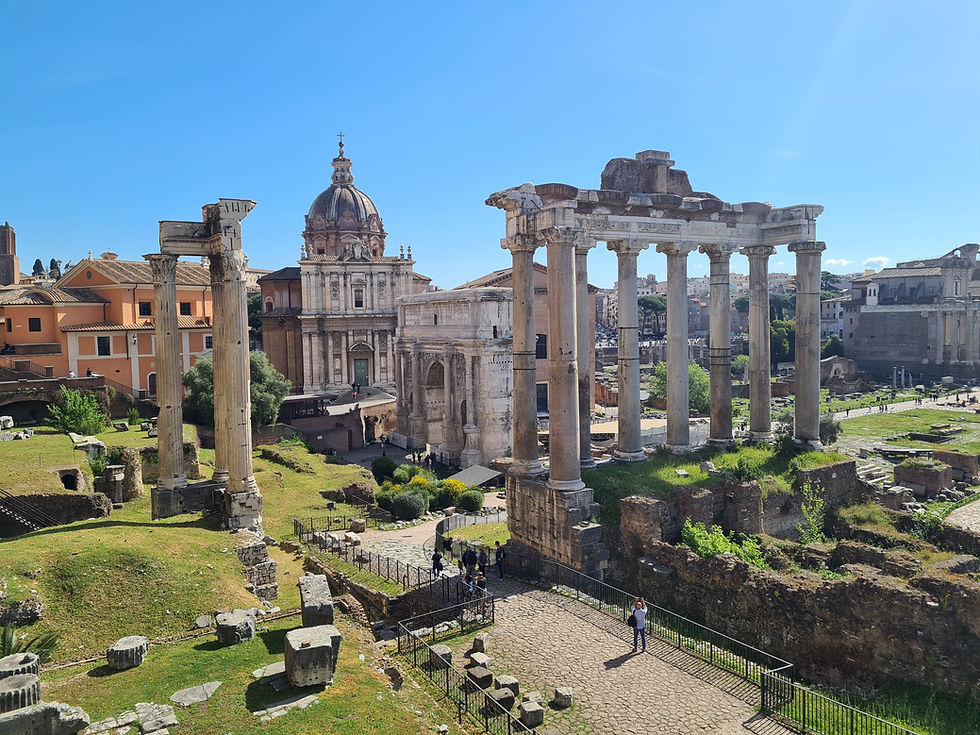
The Roman Forum was the center of public life in Rome for more than a millennium: a plaza, a tribunal, a religious space, and a political stage. What you see today is a layering of centuries, with Republican temples, imperial arches, ancient basilicas, and churches built directly over earlier structures.
To avoid getting lost, use the Via Sacra as your central axis. It runs through the Forum and helps organize the visit.
What Is the Difference Between Palatine Hill and the Roman Forum?
The Roman Forum was the city's civic and political center at ground level, where citizens gathered, laws were debated, and temples were built over generations.
Palatine Hill is the elevated area directly above, where the city was legendarily founded and where emperors eventually built their private palaces.
They are connected but distinct: the Forum is public and communal, Palatine Hill is elevated and imperial.
The Republic: where Rome learned to govern itself
Year | Event | Site |
Curia Julia | Building associated with the Roman Senate; rebuilt by Julius Caesar, completed by Augustus | Preserved interior is one of the Forum's surprises when open |
Rostra | Platform for great public speeches; named after bronze rams of captured enemy ships | Where political oratory shaped Rome's destiny |
Temple of Saturn | Eight columns still standing; one of the most recognizable images of the Forum | Connected to Rome's public treasury |
House of the Vestals | Complex where the Vestal Virgins lived, responsible for keeping Rome's sacred fire burning | Central garden is one of the most peaceful spaces in the Forum |
The Empire: when power is concentrated around the emperor
Arch of Titus | Built after the Roman victory in Judea and destruction of Jerusalem in 70 AD | Interior reliefs turn military conquest into public memory |
Arch of Septimius Severus | At the other end of the Via Sacra, marking imperial power at the start of the third century | Reliefs of military campaigns in the east |
Temple of Antoninus and Faustina | Original second-century columns still support a baroque church from the 17th century | Pagan Rome and Christian Rome layered into one building |
Basilica of Maxentius | Monumental structures from the early fourth century | Gives one of the best senses of the Forum's scale in late Rome |
If you have a compatible ticket, fit in the Curia Julia or the Horrea Piperataria if they are open on the day.
Practical tips for this stop:
The Forum is large and exposed. Bring water and wear a hat between May and September.
Use the Via Sacra as your axis to avoid wandering in circles.
If visiting without a guide, read or listen to a short explanation before entering. In the Forum, context changes everything.
Estimated time: 2h to 2h30. Add 30 minutes if including SUPER sites.
Stop 3: Palatine Hill, Where Rome Becomes Imperial Power
Palatine Hill is the central hill of Rome, flanked by the Roman Forum on one side and the Circus Maximus on the other. It is one of the oldest parts of the city: excavations show human occupation going back to at least the 10th century BC, and legend says this is where Romulus founded Rome in 753 BC.
Over time, the hill transitioned from an aristocratic residential area to the symbolic address of imperial power. Augustus lived there, and subsequent emperors expanded the palaces until they covered almost the entire hill. Not by accident, the word "palace" comes from Palatine.
What to see:
Hut of Romulus (Cabins of Romulus): Area associated with the archaic huts of Palatine Hill. Visually understated, but important: this is where founding myth and archaeology meet.
House of Augustus and House of Livia: Two of the most valuable SUPER sites on Palatine Hill, especially for their preserved wall paintings. If open, prioritize these.
Palatine Museum: A small museum inside the hill. Worth a quick stop if you have time, but can be skipped on a condensed visit.
Imperial palaces: Ruins of Domitian's palaces give a sense of imperial scale, even when imagination is needed to reconstruct the full picture.
Farnese Gardens: Renaissance gardens built over ancient Palatine structures. A good pause before the viewpoint.
Palatine Hill viewpoint: The view from the top of Palatine Hill, with the Forum below and the Colosseum in the background, is one of the best angles in the entire Ancient Rome archaeological area. Save a few minutes here. It is the natural close of the itinerary.
How Physically Difficult Is Climbing Palatine Hill?
Palatine Hill involves uphill walking and uneven terrain. It is not technically demanding, but it requires comfortable footwear and some stamina. If mobility is a concern, take this section slowly and focus on the main viewpoint rather than covering every corner. Strollers are not recommended given the irregular ground.
Practical tips for this stop:
Wear closed-toe shoes and plan for uneven ground.
Use the MyColosseum app for the hill map. On-site signage can be inconsistent.
Check SUPER sites before leaving your hotel. Arriving at Palatine Hill to find the main space of the day is closed is an easy frustration to avoid.
Estimated time: 1h30 to 2h. With SUPER sites open, 2h to 2h30.
How Far Apart Are the Three Sites? Navigation Between Stops
Ancient Rome in one day map
Use this map to visualize how close the three sites are. The route works best when you start at the Colosseum, continue through the Roman Forum, and finish on Palatine Hill without leaving the archaeological area unnecessarily.

To help you pace your footsteps, keep these quick logistics in mind:
Route | Distance | Notes |
Colosseum to Roman Forum | About 5 minutes on foot along the Via Sacra | Main Forum entrance on Via della Salara Vecchia, near the Arch of Titus |
Roman Forum to Palatine Hill | Inside the same archaeological area | Ascent signposted, but path confusing due to ruins, side access points, and elevation changes; use official map or MyColosseum app |
Where to pause
The best pause is between the Roman Forum and Palatine Hill, after roughly two hours of walking on uneven, sun-exposed terrain.
Avoid restaurants directly next to the Colosseum or Forum: menus in many languages, food photos on the door, and pressure to sit down are reliable warning signs. If time is tight, a simple snack bought before entering works better than stopping mid-route.
If you want a proper meal, save it for after Palatine Hill and head toward Monti, Celio, or Testaccio, residential neighborhoods 10 to 15 minutes on foot with restaurants frequented by locals.
TripnSense tip: Do not sacrifice Palatine Hill for a long midday lunch. The final view over the Forum and the Colosseum is an essential part of the experience.
How to Do This Itinerary in 4 or 5 Hours

Can you visit the Colosseum, Roman Forum, and Palatine Hill in half a day?
Yes, but it will be a condensed visit. In 4 or 5 hours, prioritize the Colosseum, the Via Sacra through the Roman Forum, and the main Palatine Hill viewpoint. Cut the Palatine Museum, most of the SUPER sites, and any long midday break.
The full itinerary calls for 5 to 7 hours. If time is limited, the key is to define what to cut, and not compress everything.
4-hour version:
Stop | Time | What to See |
Colosseum | 1h | Main areas, arch views, hypogeum only with Full Experience |
Roman Forum | 1h30 | Via Sacra, Rostra, Arch of Titus, Temple of Saturn |
Palatine Hill | 30 min | Main viewpoint and House of Augustus if open |
5-hour version:
Stop | Time | What to See |
Colosseum | 1h15 | Main areas and second level |
Roman Forum | 2h | Full Via Sacra, Curia Julia, House of the Vestals, Arch of Titus |
Palatine Hill | 45 min | Viewpoint, Farnese Gardens, House of Augustus if open |
What to cut without regret:
Skip the Palatine Museum and leave Domitian's imperial palaces for a longer visit. Among the SUPER sites, prioritize only the House of Augustus if it is open and fits your route.
An honest note:
Within 4 hours, you will see the essentials, but you will probably leave feeling the Forum deserved more time. It is the site that most rewards those who linger, and most frustrates those who rush through.
If you have to choose between spending more time at the Forum or at Palatine Hill, stay longer at the Forum.
Practical Tips for Visiting in 2026
Getting there: Metro Line B to Colosseo, bus lines 75/85/87/571, tram 3.
Check official hours the week of your visit. Opening and closing times vary by season, and some SUPER sites follow separate calendars.
Book in advance, especially from April through October. While walk-up tickets exist, popular time slots regularly sell out, and arriving without a reservation risks losing your preferred entry window or missing the Colosseum entirely.
Bring ID. Colosseum tickets are non-transferable, and you may be asked to show identification.
Pack light. Backpacks are generally allowed, but large bags may slow you down at security.
Download the MyColosseum app before leaving your hotel. Use it for maps, routes, and orientation inside the complex, especially at the Colosseum
Plan for heat and uneven ground. From May to September, bring water, sun protection, and comfortable closed-toe shoes.
Avoid buying from street sellers. Use the official platform or reputable tour providers.
If you have flexibility, avoid July and August for this itinerary: heat and crowds make the Forum and Palatine Hill much harder to enjoy.
What Is Forbidden at These Sites?
Touching or climbing on ancient structures is prohibited throughout the archaeological area.
Drones are not allowed.
Flash photography is restricted inside enclosed spaces and SUPER site interiors. Personal photography is generally permitted in open-air areas.
Eating and drinking inside the monuments is not permitted.
Treat the ruins with the same respect you would a museum.
Do You Need a Guided Tour or Can You Explore Solo?
It depends on what you want from the visit.
The Colosseum impresses even without much explanation. The scale, the arches, the arena, and the hypogeum already tell part of the story. The Roman Forum and Palatine Hill, however, require more context.
Without a clear historical framework, many ruins simply look like scattered stones. With a knowledgeable guide, the visit gains another layer: you understand where the Republic functioned, how imperial power installed itself, and why that collection of ruins still matters.
Four visitor profiles:
Profile | Best Choice | Ideal For |
Prefers full independence | Official ticket plus this itinerary read the night before | Those who like setting their own pace |
Wants context without a group | Audio guide or support app | Explanation without depending on a live guide |
Wants to genuinely understand Ancient Rome | Small-group guided tour | Understanding the Forum, the Republic, the Empire, and the function of the ruins |
Wants the most complete experience | Tour with arena, underground, and special areas if available | Confirm whether SUPER sites are included before booking |
Should You Hire a Private Guide or Join a Group Tour?
A private guide gives you full flexibility, the ability to linger where you want, and a tailored narrative. A group tour is typically more affordable and still provides strong historical context.
For most first-time visitors, a small-group tour strikes the right balance. If the Roman Forum is a particular priority and you want to absorb it fully, a private guide is worth the extra cost.
For cancellation policies, tour inclusions, and what to expect from specific providers, see our full guide: Is GetYourGuide Legit?
Are English-Speaking Guides Available?
Yes. English-language tours are widely available through platforms like Viator and GetYourGuide. Filter by language before booking, read recent reviews carefully, and look for guides who specialize in Ancient Rome rather than general Rome tours.
The difference between a good guide and an exceptional one significantly changes the experience.
Which Site Has the Best Audio Guide or App?
The MyColosseum app is the official tool for the Colosseum and covers navigation across the complex. For the Roman Forum and Palatine Hill, third-party audio guide apps like Rick Steves Audio Europe or dedicated Rome archaeology apps provide useful context.
No single app covers all three sites equally well, so it is worth downloading one or two options before your visit.
For digital tickets, maps, and the MyColosseum app, an Airalo eSIM is useful if you want mobile data working as soon as you arrive in Rome.
TripnSense tip: If you are going to invest in a guide, prioritize the Roman Forum over the Colosseum. The Colosseum impresses on its own. The Forum needs context to come alive.
Is One Day Enough or Should You Split It Into Two Days?
One day is enough to understand the arc of Ancient Rome and leave with a genuine sense of each site. It is not enough to explore everything thoroughly.
If you have a second day, use it to move beyond the Colosseum, Forum, and Palatine axis without losing the historical thread.
Add the Imperial Fora, partially visible from Via dei Fori Imperiali, and the Circus Maximus, where the scale of the largest chariot racing stadium in the Roman world is still perceptible.
With more time, include the Baths of Caracalla, one of the great public bathing complexes of the imperial period, and finish on the Capitoline Hill with a view over the Roman Forum.
The Capitoline Museums deserve their own dedicated visit if you want to see foundational sculptures of Ancient Rome, including the Capitoline Wolf and the equestrian statue of Marcus Aurelius.
Can You Combine This With Other Rome Attractions on the Same Day?
In theory, yes. In practice, it makes for an exhausting day where nothing receives the attention it deserves. The Colosseum, Forum, and Palatine Hill together take 5 to 7 hours. The Vatican, done properly, takes at least 3 to 4 hours. Splitting them into separate days is the better choice for anyone who wants to leave with an understanding of what they saw.
What First-Time Visitors Most Often Overlook
What Visitors Overlook | Why It Matters | What to Do Instead |
The Forum needs more time | This is where Ancient Rome’s political story becomes clearer. | Do not let the Colosseum take over the day. |
The Palatine viewpoint matters | It gives the clearest visual sense of the whole archaeological area. | Save time and energy for the final view. |
SUPER sites are not just extras | Houses like Augustus can feel more vivid than open-air ruins. | Check what is open before adding them. |
The Forum needs context | Without a basic Republic vs. Empire framework, many ruins blur together. | Use a guide, audio guide, or short primer. |
Heat changes the route | From May to September, the Forum and Palatine can feel exposed by late morning. | Bring water and avoid the hardest walking at midday. |
Where to Stay in Rome for This Itinerary
If your priority is visiting the Colosseum, Roman Forum, and Palatine Hill without losing time to transit, look for accommodation in Monti, Celio, or the Historic Center.
Monti: One of the most interesting bases in Rome. Right next to the archaeological area, full of excellent restaurants, charming streets with local life, and easy access to the Cavour or Colosseo metro stations.
Celio: Works well for anyone who wants to wake up practically next to the Colosseum but prefers a slightly more residential and quieter atmosphere.
Historic Center: The best choice for doing everything on foot, also near the Pantheon and Trevi Fountain, but typically comes with higher rates.
Staying in Monti or Celio makes this itinerary much easier, especially if you want the first morning Colosseum slot.
I would start by comparing hotels in Monti and Celio, especially if you want the first morning Colosseum slot. You can search Rome hotels on Booking.com.
Get in the Mood Before You Go
The Colosseum impresses instantly, but the Roman Forum asks you to read fragments: a temple here, a Senate building there, an arch that once turned conquest into public memory.
Arriving with even a basic sense of the Republic, the Empire, and the role of Palatine Hill makes the whole route feel less like scattered ruins and more like a story unfolding under your feet.
Films and series:
Gladiator (2000) | useful for imagining the symbolic scale of the Colosseum and imperial Rome | Watch for entertainment, not accuracy | |
Rome (HBO, 2005) | One of the most immersive series about the end of the Roman Republic | Two episodes are enough to arrive at the Forum with a more concrete picture of politics, street life, religion, and power |
For reading, the first few chapters of SPQR by Mary Beard give a solid foundation without requiring you to finish the book before your flight.
To follow Roman history beyond Italy, Istanbul is the natural next chapter. My Istanbul itinerary explores the former Constantinople through churches, mosques, palaces, cisterns, and imperial streets.
Practical tip: If you have no time for films, series, or books, reread the "Best Order to Visit" section the night before. It gives the basic narrative thread to get more out of the day.
Frequently Asked Questions
What is the essential Ancient Rome itinerary in Rome?
The essential Ancient Rome itinerary is the Colosseum, Roman Forum, and Palatine Hill. Together, they show imperial spectacle, political life, and the hill where Rome's founding myth and imperial power meet.
Do I need to book tickets in advance, or can I buy at the gate?
Book in advance, especially between April and October. Colosseum time slots sell out regularly, and walk-up availability in high season is unreliable. You may face a long wait or find only inconvenient slots that leave too little time for the Roman Forum and Palatine Hill. Buy through the official platform several weeks ahead. If availability is gone, Viator and GetYourGuide often have tours or tickets with entry included.
What is the best order to visit the Colosseum, Roman Forum, and Palatine Hill?
The best order is Colosseum → Roman Forum → Palatine Hill: first the imperial spectacle, then the political heart of Rome, and finally power seen from above. If avoiding crowds is your absolute priority, starting at Palatine Hill can work better on some days.
How much time do I need for all three sites?
Plan 5 to 7 hours for the Colosseum, Roman Forum, and Palatine Hill. With 4 or 5 hours, you can still see the essentials, but you will need to skip the Palatine Museum, most SUPER sites, and a longer lunch break.
What is included in a combined Colosseum and Roman Forum tour?
Usually timed entry to the Colosseum, access to the Roman Forum, and entry to Palatine Hill (same archaeological area). Some tours add arena floor, underground chambers, SUPER sites, or a specialist guide. Always check inclusions before booking.
Can I visit the Roman Forum and Palatine Hill without going to the Colosseum?
Yes. The Forum Pass SUPER gives access to the Roman Forum, Palatine Hill, Imperial Fora, and SUPER sites without Colosseum entry. Good for a second visit, focused only on the archaeological area.
Is one day enough for the Colosseum and the Vatican?
It is possible, but not ideal. The Colosseum, Forum, and Palatine Hill take 5 to 7 hours, while the Vatican needs at least 3 to 4 hours. Split them into separate days if you want to enjoy both properly.
Are there specific tips for visiting in winter or on rainy days?
In winter, sites are less crowded but close earlier. Under heavy rain, the Forum and Palatine Hill can be uncomfortable due to uneven terrain. Between November and February, choose the first morning slot to maximize daylight. Check the official site before leaving if there is heavy rain.
Is this itinerary suitable for children or teenagers?
Yes, for teenagers and older children. The full itinerary may be too long for young children. With young children, use the 4-hour version: Colosseum, Via Sacra through the Forum, and Palatine Hill viewpoint. Cut the Palatine Museum and most SUPER sites. Strollers are not recommended due to irregular terrain.
How wheelchair accessible are the Forum and Palatine Hill?
The Colosseum is generally easier to navigate than the Roman Forum and Palatine Hill. The Forum and Palatine have uneven ground, slopes, and ancient paving, so visitors with mobility needs should check the official accessibility guidance before booking and plan a slower route.


Comments