
What to Do in Verona, Italy
Wondering what to do in Verona? Start at the Arena, walk to Castelvecchio and Ponte Scaligero, then continue through Porta Borsari to Piazza delle Erbe. On your second day, cross Ponte Pietra for the view from Castel San Pietro and the Roman Theatre. Two full days were enough for me; three nights also gave me time for opera and the city lit up at night. With only one day, I would see fewer interiors. Juliet’s House disappointed me: its cramped, crowded courtyard would be the first thing I cut.

What to Do in Verona: Six Stops I Would Keep
Here are my priorities in walking order across the two days. You can enjoy much of this route from the streets, bridges, and viewpoints, then choose the interiors that interest you.
Arena di Verona: See the amphitheater from Piazza Bra; go inside if you're interested in its Roman history, and return for a performance if the program appeals.
Castelvecchio and Ponte Scaligero: Cross the bridge for the river view. Add the museum if you want more time with the castle and its art.
Porta Borsari and Piazza delle Erbe: Walk through the Roman gate into the historic center. I preferred looking around the square to sitting in its busiest cafés.
Ponte Pietra: Cross the Adige and come back at night if you can. The illuminated bridge was one of my favorite sights.
Castel San Pietro viewpoint: Take the funicular up for the view. The castle isn't open to visit inside.
Roman Theatre and Archaeological Museum: Explore this side of the river; check for an open-air performance during your stay.
Is Verona Worth Visiting? My Honest Impression
Absolutely. I arrived after several days at Lake Garda, and the change of scenery was welcome. Verona felt like an open-air museum: almost every turn brought me to another square, bridge, façade, or architectural detail that made me stop.
Its appeal goes beyond individual monuments or the story of Romeo and Juliet. I loved the scale of its historic streets, the way the Adige winds through them, and the different atmosphere after the lights come on at night. With two full days, I saw the places I cared about and still had time to sit in a square, have a drink, and watch the city go by.
Table of Contents
Verona in 2 Days: The Route at a Glance
1: Arena and historic center | Arena, Castelvecchio, Ponte Scaligero, Corso Cavour, Porta Borsari and Piazza delle Erbe. Add Torre dei Lamberti if you want another view. | The fuller day. Walk between stops and be selective about which places you enter. |
2: Adige River and viewpoints | Verona Cathedral, Ponte Pietra, the funicular, Castel San Pietro, the Roman Theatre and Archaeological Museum. | Leave time for the view and a walk along the river. |
Save an evening for the illuminated city, too. If a performance appeals to you, check the schedules for the Arena and the Roman Theatre before planning the rest of your visit.
Where to go inside: The Arena, Castelvecchio Museum, Torre dei Lamberti, Verona Cathedral and the Roman Theatre complex are choices, not obligations.
Porta Borsari, the two bridges, the squares, and the Castel San Pietro viewpoint reward you simply for walking there. I would choose my museum visits based on my interests and the weather, rather than see everything on Day 1.
Day 1: Arena, Castelvecchio and the Historic Center
Day 1 is the busier of the two. You can walk the whole route, but visiting the Castelvecchio Museum and climbing Torre dei Lamberti will fill much of the day. Decide which interiors matter to you so you have time for the streets in between.

I started at the Arena di Verona, the Roman amphitheater that has become the city’s symbol. Even without a performance, its scale and preservation are impressive. I returned at night for an opera and felt Verona's history more immediately there than almost anywhere else: this ancient structure is still part of the city’s cultural life.
From the Arena, I went to Castelvecchio, the medieval castle that now houses a museum, and crossed Ponte Scaligero, the bridge built as part of the complex. Together, they make one of Verona’s most striking scenes. Stop on the bridge and look back toward the castle and out across the Adige.

I continued along Corso Cavour toward Porta Borsari, a surviving gateway of Roman Verona. I loved this stretch because the city changed as I walked: the castle fell behind me, shops and cafés appeared, and then I passed through an ancient gate into the heart of the historic center.
I passed the archaeological area and reached Piazza delle Erbe, near the site of the Roman forum. Palazzo Maffei, with its Baroque façade and statues above the square, caught my eye immediately. The buildings here come from different periods, and the square is beautiful, but I found it too busy for a leisurely drink. The bars on the side streets suited me better.
Nearby, Torre dei Lamberti offers a wide view of the city. The line was long, the stairs seemed endless, and it was very hot on the day I climbed. There is a lift for an additional fee. I skipped it and regretted it. The view was worth seeing, but in that heat I would take the lift next time.

I also stopped at the Arche Scaligere, the elaborate Gothic tombs of the family that ruled medieval Verona. They're worth a look even if you only have a few minutes.
Juliet’s House, famous for its courtyard and the balcony associated with Shakespeare’s story, was a disappointment. I found it small, crowded, with no charm, and the experience didn’t live up to the hype. If you have limited time in Verona, visit the Arena, Castelvecchio or Ponte Pietra instead.
After that, I let the afternoon become a more open-ended walk, with time for lunch, a drink, and whatever caught my attention. That is one of the pleasures of Verona: you can find something memorable on the way to a place you had planned to see.
Day 2: Verona Cathedral, Ponte Pietra and the Roman Theatre
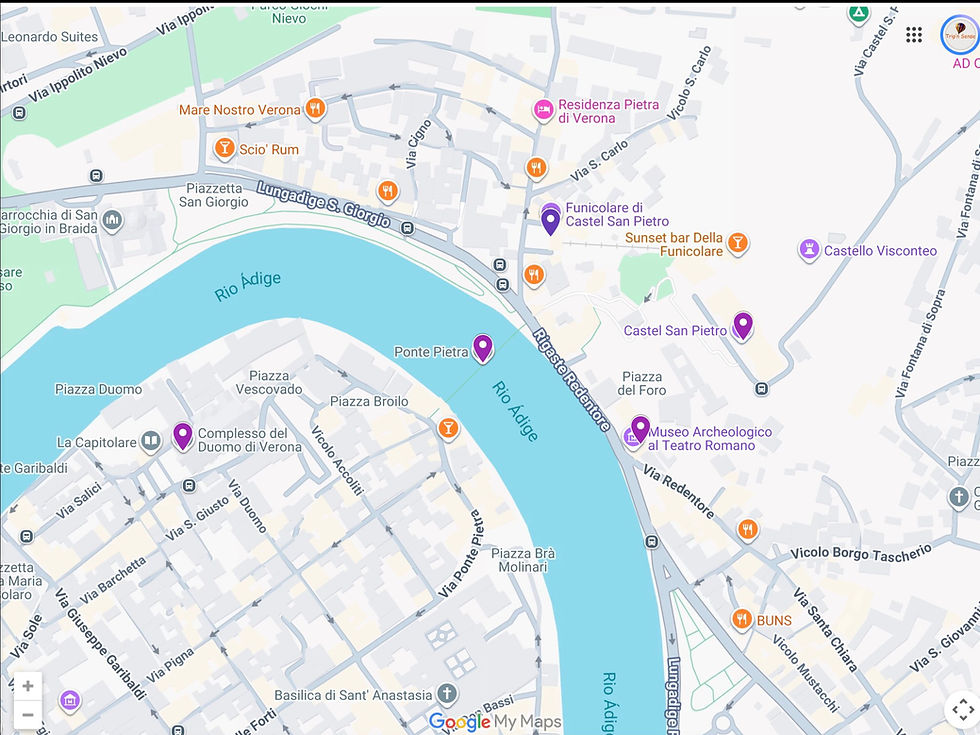
I began my second day at Verona Cathedral, often called the Duomo. Its quieter square, close to the river, gave me a welcome change of pace after the busy center. It is worth visiting for both the architecture and a pause.
From there I walked to Ponte Pietra, Verona’s oldest bridge. I crossed slowly, looking at the buildings on both banks of the Adige. Later, I came back after dark and found the illuminated bridge even more beautiful. It is one of the images of Verona that has stayed with me.

Across the river, I took the funicular up to Castel San Pietro. The reason to go is the view: the bend of the Adige, the bridges, rooftops, and towers all spread out below you. Give yourself a few minutes to take it in. The castle itself is not open for interior visits.
On the way down, I visited the Roman Theatre and its Archaeological Museum, set into the hillside near the river. They gave me another perspective on ancient Verona. Unlike at the Arena, the ruins here feel woven into the landscape. I also attended a performance at the theatre, and seeing the historic space in use made it especially memorable.
Walk a little beyond the individual attractions on this side of the river, in Veronetta. Away from the busiest streets of the historic center, I could appreciate the architecture more slowly and see another side of a city that is so easy to explore on foot.
These are the views from my walk that I would photograph again:
Castel San Pietro: The Adige, bridges, and rooftops together.
Ponte Scaligero: Red-brick arches and the river beside Castelvecchio.
Ponte Pietra at night: The illuminated bridge above the Adige.
Torre dei Lamberti: Verona’s rooftops from above.
If you prefer a gentler route: I took the funicular rather than climbing the hill to Castel San Pietro. On a hot day, I would take the lift at Torre dei Lamberti, too; I regretted using the stairs. You can also choose one museum rather than filling the day with indoor visits.
What to Do in Verona in One Day
Choose fewer stops and spend more time walking. I would start at the Arena, continue to Castelvecchio and Porta Borsari, then reach Piazza delle Erbe. From there, head for Ponte Pietra and, if time and energy allow, go up to the Castel San Pietro viewpoint.
I would leave the museums and Torre dei Lamberti for a longer visit, particularly if lines are long. This route gives you a sense of Verona without turning the day into a race.
Only half a day? See the Arena from Piazza Bra, walk through the center to Piazza delle Erbe, then continue to Ponte Pietra. You will get a feel for the city, but you will see it mostly from outside. I would not squeeze a museum or the Juliet’s House line into that short visit.
What to Do in Verona at Night
Verona stays lively in the evening, with people in the streets and outdoor tables filling up. I enjoyed wandering without a fixed route and returning to Ponte Pietra once the lights came on. With the Adige flowing beneath it, the bridge looked even better than it had by day.
During opera season, the Arena di Verona becomes the buzz of the evening. The performance I attended was very good. The acoustics impressed me less, but the atmosphere made the night worthwhile. Elegantly dressed Italians and casually dressed visitors streamed into the same Roman amphitheater to watch an art form that is still alive here.
I also saw a play at the Roman Theatre. The mood was more informal, and everything was well organized. Watching a performance outdoors under the stars, in that setting, was wonderful. Between the shows and the evening walks, my three nights in Verona mattered as much to me as the two sightseeing days.
How Many Days in Verona Is Enough?
Two full days were enough for me. I stayed three nights so I could enjoy the opera, a performance at the Roman Theatre, and walks after dark. A third full day is not necessary for the main sights.
If you have one, you could return to the river at a slower pace, enjoy a longer meal, or choose a single place at Lake Garda. That is an option for extending the trip, not a third day of Verona attractions I personally followed.
What to Do in Verona When It Rains
Switch the order of the two days rather than give up the walk. If rain is forecast for the riverside and Castel San Pietro part of Day 2, use that time for an indoor visit such as the Castelvecchio Museum, Palazzo Maffei’s art collection, the cathedral, or the Archaeological Museum.
Keep Ponte Pietra and the viewpoint for a clearer spell. Check opening hours before you change the order, especially if a performance affects daytime access.
Where Is Verona, and How Do You Get There?
Verona is in the Veneto region of northern Italy, between Milan and Venice and close to Lake Garda. The Adige River runs through the city and shapes some of its loveliest views. I came to Verona after several days at the lake, a combination that worked beautifully for my trip.

Verona Porta Nuova is the main railway station, with trains connecting the city to other parts of Italy. Piazza Bra and the Arena are about 1.5 km from the station, roughly a 20-minute walk, or you can take a short bus ride.
Depending on where you start at Lake Garda, a bus may also be an option. From Verona Airport, a shuttle bus connects with Porta Nuova. Check the current route and timetable before you travel.
If Verona is one stop on a longer trip, my guide to planning a trip to Italy can help you choose your route, bases and transport before you book.
Do You Need a Car in Verona?
No. Once you are in Verona, walking is the best way to explore. The central sights are fairly close together, and many of the façades and small streets I loved were discovered between planned stops.
In the historic center, you can generally manage the practical parts of a visit in English at hotels, museums, and restaurants; a little Italian is always welcome.
I also took a tourist road train for about an hour to get an overview before continuing on foot. For the Castel San Pietro viewpoint, I used the funicular.
If you arrive by car, pay close attention to the ZTL, the restricted traffic zone in the historic center. I received fines in Verona, so I do not treat this as a minor detail.
Before following your GPS to a hotel, confirm the permitted access route and parking arrangements. If your hotel is inside the ZTL, ask whether it will register your license plate and how to provide the details. The NH Collection Palazzo Verona, where I stayed, is in this area.
I explain the fines and what I learned in my guide to the ZTL in Italy. That article is in Portuguese, but the experience is mine and directly relevant if you plan to drive.
Verona Tickets: What Should You Book Ahead?
You can enjoy a great deal of Verona without an admission ticket: Piazza delle Erbe, Porta Borsari, Ponte Scaligero, Ponte Pietra, and the Arena from outside are part of the walking route. Museums, the Torre dei Lamberti lift, and performances require tickets. I would decide which experiences matter to me before buying a pass.
Keep a daytime visit to the Arena separate from an opera or concert ticket. They are different experiences and require different admission. If you want a performance, check the program and book through the Arena’s official website. The Roman Theatre’s performance schedule also changes by season.
For museum opening hours and admission, use the official Verona museums website. If you plan to enter several attractions, check whether the Verona Card suits your plans.
A card does not mean every visit can be spontaneous: check the current booking requirements for Juliet’s House. The lift at Torre dei Lamberti costs extra, and a card does not replace a ticket for an opera or play.
On performance days, daytime access to the Arena may end earlier.
Where to Stay in Verona: My Experience
I stayed at the NH Collection Palazzo Verona. Its location made it easy to explore on foot and return after evening performances. Overall, I thought it was a good hotel, but the air conditioning in my room was a persistent problem: it ran too cold, and I couldn't switch it off. I would consider staying there again for the location, while keeping that experience in mind.
For a first visit without a car, staying in or close to the historic center makes walking and evenings out straightforward. If you are driving, check ZTL access and parking before booking. My hotel’s location was convenient on foot, but I got some fines for not paying attention to the ZTL.
Verona’s historic center has hotels for a range of budgets. Compare your options and find one that suits your plans on Booking.com.
Where I Ate in Verona
My best meal in Verona was at Trattoria Al Pompiere. It remains one of my good memories of the trip. For a drink, I preferred the bars on the side streets off Piazza delle Erbe. The square is lovely and lively, but I was more comfortable sitting a little away from the busiest part.
If you want to try a regional dish, look for risotto all’Amarone, made with local wine. Another Verona specialty is pearà, a peppery sauce traditionally served with boiled meats. To drink, look for Amarone, Valpolicella, or Soave, wines from the area around Verona.
When Is the Best Time to Visit Verona?
For long walks, I would choose spring or fall, when the heat is less tiring. Summer has its own reason to visit: opera at the Arena and other outdoor performances.
I traveled during the performance season and loved those evenings, although the heat made some daytime visits, particularly my climb up Torre dei Lamberti, much harder. If opera is a priority, look at the performance calendar before setting your dates.
Verona or Lake Garda: Where Should You Stay?
They offer different trips. Stay in Verona if you want historic streets, museums, restaurants, and performances within easy walking distance. Stay at Lake Garda if the lake, its towns, and time by the water are the main reason for your visit.
I spent several days at Lake Garda before coming to Verona for three nights. I was glad I experienced both, but I would not try to see the whole lake as a single day trip. From Verona, you can choose one town, such as Bardolino, for a taste of the eastern shore. Check the bus timetable for your dates rather than trying to fit several distant towns into one day.
If I had only six nights for the lake and Verona together, I would stay all six at Lake Garda and visit Verona from a base on the southern part of the lake. Three nights in Verona were lovely on my trip, but three nights at Garda would feel too short for the different parts of the lake I wanted to see. With more time, staying in both places is the more relaxed choice.
My guide to the five best towns on Lake Garda can help you choose where to spend that time. If you have longer, see how I put the different shores together in my 10-day Lake Garda itinerary.
Verona FAQs
Can You See Verona in One Day?
You can see several highlights, including the Arena, Castelvecchio, Piazza delle Erbe and Ponte Pietra. Choose only a few interiors so you still have time to enjoy the streets and architecture.
Is Juliet’s House Worth Visiting?
I would skip it if time is limited. Juliet’s House is near Piazza delle Erbe, but visitors enter through the Teatro Nuovo in Piazzetta Navona and exit at Via Cappello 23. You can book the courtyard alone or the courtyard and house; advance online booking is required, even with a Verona Card. Check current admission arrangements before going.
The balcony did not make the experience worthwhile for me. The house is medieval, but the balcony was added in the 20th century. The courtyard appears in Letters to Juliet.
I would spend that time at the Arena, Castelvecchio, or Ponte Pietra instead. If the balcony photo matters to you personally, that is the reason to make an exception.
Is Verona Nicer Than Venice?
I wouldn’t rank one above the other. Both are worth visiting, but they offer completely different experiences. Venice is a place I think everyone should see at least once: the canals, St. Mark’s Basilica and the little streets where getting lost is part of the pleasure. It is also much more touristy. Both cities reward exploring on foot, and I would visit both. You can travel between them by train and see one as a day trip from the other, but if you have the time, I would spend three nights in each.
Can You Visit Lake Garda from Verona?
Yes. For a day trip, choose one town rather than trying to cover several shores. Pick Bardolino if you want to explore the lake’s wine culture, or Sirmione if you prefer a historic center, a castle and a walk along the peninsula. Check the transport connections for the town you choose. One day gives you a taste of Lake Garda, but not the full experience.
Is the Verona Card Worth It?
It depends on how many paid attractions you plan to enter. Compare your actual route with the card’s current inclusions and opening hours. Remember that performances need separate tickets, Juliet’s House may require a timed booking, and the Torre dei Lamberti lift costs extra.


Comments