
Sardinia vs Sicily: Which Italian Island Should You Actually Choose?
Quick Verdict: Sardinia vs Sicily
Choose Sardinia if you want a slower trip built around the coast, nature, scenic driving and distinctive Nuragic archaeology.
Choose Sicily if you want a denser mix of historic cities, archaeology, volcanoes, food, wine and cultural variety.
If you have fewer than seven days, pick one island rather than trying to combine both.

Sardinia vs Sicily is often framed as a choice between beaches and culture, but having travelled through both islands, I don’t think that comparison really holds up. I’m a big fan of both, and I never see beach time and cultural experiences as competing choices when I travel.
Sardinia has remarkable beaches, but also striking archaeology, quiet towns and a distinct food culture. Sicily has a rich history, as well as some of Italy’s best beaches and landscapes that range from volcanoes and vineyards to the coastline.
Both Italian islands offer far more variety than their stereotypes suggest.
Sardinia vs Sicily at a Glance
If you’re looking for… | Sardinia | Sicily |
Beaches | Best fit. Turquoise water, sandy coves and spectacular coastline | Excellent beaches, often easier to combine with towns and sightseeing |
History and archaeology | Distinctive Nuragic sites, plus Phoenician and Roman heritage | Slight edge. Greater historical variety, with Greek, Roman, Arab-Norman and Baroque layers |
Cities and towns | Cagliari, Alghero and smaller historic towns | Best fit. More major cities and convenient urban bases |
Food and wine | Regional cuisine, Cannonau and Vermentino | Slight edge. Street food, markets, regional cooking and Etna wines |
Landscapes | Coast, mountains and wide-open scenery | Volcanoes, vineyards, mountains, historic towns and coast |
Cost | Can be expensive in peak summer and famous coastal areas | Best fit. Broader range of budget options overall |
Without a car | Best with a carefully chosen base | Slight edge. More useful rail and bus connections |
Road trip | Best fit. Scenic coastal driving and a slower rhythm | More varied, but often busier between regions |
July and August | Best fit. Outstanding for beach-focused trips, but prices rise sharply | Hot and busy, with a stronger mix of beach and culture |
Shoulder season | Excellent for road trips, archaeology and nature | Slight edge. Stronger for cities, archaeology, food, wine and Etna |
Choose Sardinia If… / Choose Sicily If…
Choose Sardinia if… | Choose Sicily if… |
You like combining coast, archaeology, nature and smaller cities at a slower pace | You want a denser mix of major historic cities, archaeology and cultural sights |
You enjoy scenic driving and exploring different landscapes between stops | You prefer more urban bases and a broader range of city-based experiences |
Nuragic archaeology and Sardinia’s distinct island history interest you | You want Greek, Roman, Arab-Norman and Baroque layers in the same trip |
You prefer a less urban rhythm without giving up good food, wine and lively bases such as Cagliari | You enjoy markets, street food, wine and lively cities such as Palermo or Catania |
You are comfortable using a car to reach beaches, archaeological sites and smaller towns | You want more options for linking major destinations by train or bus |
You want exceptional beaches to be part of the trip, even if they are not the whole point | You want beaches combined naturally with cities, volcanoes and cultural sightseeing |
You’re traveling with young children and want beach time at a slower pace | You’re traveling with teens and want more variety beyond the beach |
You want a honeymoon centered on scenery, the coast and a quiet pace | You want a romantic trip mixing historic towns, food, wine and sightseeing |
It’s your first trip to Italy and you want something more distinctive | It’s your first trip to Italy and you want the classic mix of history, cities and food |
Which Is More Beautiful: Sardinia or Sicily?
Beauty is subjective, but Sardinia and Sicily leave very different impressions on me.

Sardinia's strongest visual appeal comes from its coastline and its sense of space. Long stretches of turquoise water, granite rock formations, mountains, and open countryside make driving across the island part of the experience. Even away from the sea, the landscape often feels wild and uncrowded.
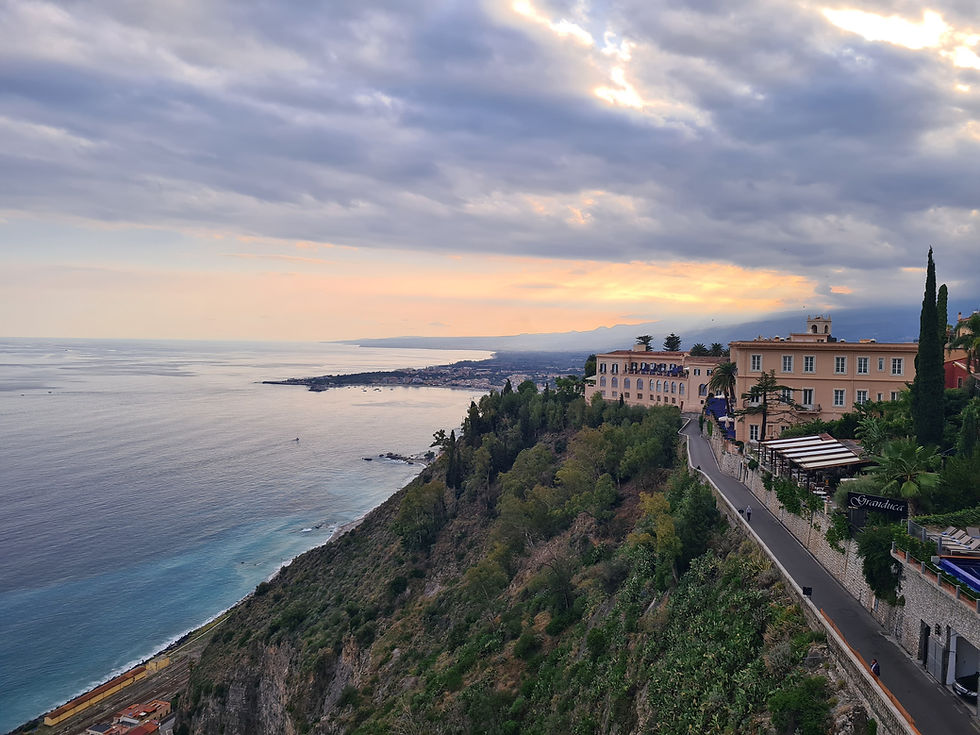
Sicily is more varied. On the same trip, you can move from the slopes of Mount Etna and vineyard-covered countryside to Greek ruins, Baroque towns and historic cities, then end the day on the coast. The scenery changes constantly, and much of its beauty comes from the way landscape, architecture and history overlap.
Etna itself captures that contrast well: towns and vineyards spread across its lower slopes, while the higher you climb, the more the ground turns bare, dark and volcanic.
Access to Etna’s higher slopes can change with volcanic conditions, and some areas may only be accessible with an authorized guide. If you want to explore beyond the easier lower areas, a guided Etna tour can simplify the logistics.

That said, Sardinia is sometimes oversold in travel photography. The island is beautiful, but the images you see online often concentrate on its most photogenic beaches, clearest water and most dramatic stretches of coastline. The reality is more varied, which is not a bad thing, but it is worth keeping expectations realistic.
So, which is prettier, Sardinia or Sicily? For sheer coastal beauty, I would choose Sardinia. For the widest range of memorable landscapes, I would choose Sicily. It really comes down to whether you are more drawn to open Mediterranean scenery and coastline, or to a constantly changing mix of volcanoes, towns, vineyards and sea.
Which Has Better Beaches: Sardinia or Sicily?

If beaches are one of the main reasons for your trip, Sardinia has the edge. The water is often clearer, the colors more striking, and the coastline has a higher concentration of beaches that feel genuinely special.
Places like La Pelosa, with its shallow turquoise water, and Cala Goloritzé, reached by boat or a hike through the mountains, are good examples of why Sardinia has such a strong reputation for beaches.
If you want to see Cala Goloritzé from the water and explore more of this coastline, there are boat trips along the Gulf of Orosei you can book in advance.
Sicily also has excellent beaches, but they are more often part of a broader itinerary rather than the defining feature of the trip.
Sardinia’s best beaches can require more planning. Some have limited parking, reservation systems, long access roads, hikes or boat access. That can make a beach-focused trip more logistically demanding, especially in July and August.
Sicily is often easier to combine with sightseeing. Places such as Cefalù, San Vito Lo Capo and Isola Bella can fit naturally into an itinerary that also includes historic towns, archaeological sites or food stops.
The beaches may be less consistently spectacular than Sardinia’s, but they can be easier to integrate into a varied trip.
So, Sardinia or Sicily for beaches? I would choose Sardinia if beach quality and clear water are a major priority. I would choose Sicily if you want good beaches without building the entire itinerary around them.
For more specific recommendations, see my full roundup of Sardinia’s best beaches.
History and Archaeology: Sardinia or Sicily?
Sardinia and Sicily both reward travelers who care about history, but in very different ways.
Sardinia’s archaeological identity is more distinctive. The Nuragic civilization left thousands of stone towers and settlements across Sardinia, with Su Nuraxi the best-known example. Sites such as Tharros add Phoenician, Punic and Roman layers, while towns like Alghero reflect later Catalan influence.

What made Sardinia especially interesting to me was discovering a history I knew almost nothing about before I went. I loved diving into the Nuragic civilization because it felt completely new to me, not just another chapter of Mediterranean history I had already encountered elsewhere. That sense of discovery is part of what makes Sardinia’s archaeology so memorable.
Sicily offers more historical density and a broader sequence of civilizations. You can move from the Greek temples of Agrigento and the ancient sites of Syracuse to Arab-Norman Palermo and Monreale, then continue into the Baroque towns of the Val di Noto.

In places like Palermo, those layers are not confined to archaeological sites; they are built into the city itself, in churches, mosaics and architecture shaped by different cultures over centuries. That is what makes Sicily feel so historically layered as you move through it.
So, Sardinia or Sicily for history? Sicily is stronger for historical variety and the concentration of major sites. Sardinia stands out for a more distinctive archaeological identity, especially if the Nuragic civilization is something you want to experience rather than read about.
Food and Wine: Sardinia or Sicily?
Both islands have strong food identities, but the experience feels different.
In Sardinia, the cuisine often feels closely tied to local traditions and specific parts of the island. Dishes such as culurgiones, fregola, bottarga, pecorino and porceddu reflect both its coastal and inland character. The same is true of the wine, with Cannonau, Vermentino and Carignano giving Sardinia a distinct regional profile.
In Sicily, food is more visible as part of everyday sightseeing. Markets, street food, bakeries and casual restaurants are woven into city life, especially in places like Palermo and Catania. Pasta alla Norma, seafood, cannoli and granita sit alongside a wine scene that ranges from Etna wines to Nero d’Avola and Marsala.
What stays with me most, though, is not a specific dish but a glass of Etna wine after a day on the volcano. After the smell of sulfur and the wind up on the slopes, a glass of red at the end of the day felt like one of the best things I drank on the whole trip.
So, Sardinia vs Sicily for food and wine? Sicily offers more variety and makes food easier to experience as part of a city-based itinerary. Sardinia feels more regional and rooted in local traditions. And neither island should be judged by its most expensive tourist areas: Taormina is not Sicily, just as Costa Smeralda is not Sardinia.
Cost: Which Island Is Cheaper?
Sicily generally offers better value than Sardinia, but I would not describe either island as cheap.
Sicily still gives you more options across different budgets, especially for food and local transport, but popular places such as Taormina and Ortigia can be expensive even outside peak summer.
Sardinia tends to get expensive faster in July and August, particularly in well-known coastal areas, where accommodation, rental cars and beach clubs can add up quickly.
Accommodation | $$–$$$ | $$–$$$ |
Food | $$ | $$ |
Rental car / transport | $$–$$$ | $$ |
Beach clubs | $$–$$$ | $$ |
July and August | $$$ | $$–$$$ |
The main difference is not that Sicily is inexpensive and Sardinia is expensive. It is that Sicily generally gives you a broader range of choices, while Sardinia’s costs can rise sharply depending on the coast and the season.
Costa Smeralda should not be used as a benchmark for all of Sardinia, just as Taormina should not be used as a benchmark for all of Sicily.
If budget is a major part of your decision, I would give Sicily a slight edge overall, but I would still plan for mid-range rather than budget prices on either island.
For more detailed planning, see my Sardinia travel planning tips, including transport, costs and practical advice.
Do You Need a Car in Sardinia or Sicily?
Whether you need a car depends on how much of the island you want to see. A stay based in one city is very different from a road trip that combines beaches, archaeological sites, smaller towns, and countryside.
Do You Need a Car in Sardinia?
Not always, but a car makes a big difference. If you are based in Cagliari or Alghero and plan a focused stay, you can manage without driving every day. Once you start combining beaches, Nuragic sites, inland villages and more remote coastal areas, having a car becomes much more useful.
A car also gives you the freedom to stop between destinations rather than structure the day around bus schedules or organized tours.
Do You Need a Car in Sicily?
You can travel between several major cities by train or bus, but that does not mean Sicily is easy to explore comprehensively without a car. I rented a car for my 14-day trip and drove across much of the island. Without it, I would have seen considerably less or spent much more time working around transport schedules and connections.
Public transport can work well for a focused itinerary based around places such as Palermo, Catania, Syracuse or Taormina.
But if you want to combine cities with archaeological sites, vineyards, smaller towns, beaches and countryside, a car gives you much more freedom and can save a significant amount of time.
Sardinia Without a Car vs Sicily Without a Car
If you are staying in one or two well-connected bases, Sicily has a slight advantage for traveling without a car. If you want to explore either island widely, though, I would rent a car on both.
Neither island is impossible without a car, but the more ambitious your itinerary becomes, the more useful one is.
For more detail on getting around Sardinia, including when a rental car makes sense, see my Sardinia travel planning tips.
Best Season to Visit Sardinia vs Sicily
The best time to visit Sardinia or Sicily depends on how much of your trip revolves around beaches versus sightseeing.
May and June are excellent on both islands. Crowds are lighter than in peak summer, temperatures are better for walking and archaeological sites, and beach conditions improve as June progresses.
July and August favor Sardinia if the trip is mainly about beaches. The tradeoff is higher prices, heavier demand and the need to book accommodation, rental cars and some popular beaches well in advance. Sicily is also hot and busy, but works well if you want to mix beach time with cities, archaeology and food.
September is probably the best overall compromise for both islands. The sea is still warm, crowds begin to ease, and sightseeing is more comfortable. If I had to choose one month that works equally well for beach time and exploring, this would be it.
October and November shift the balance toward Sicily. Cities, archaeology, food, wine and Etna remain strong reasons to visit, while some coastal restaurants and hotels in Sardinia begin closing for the off-season. Inland Sardinia remains active with autumn food traditions and festivals.
How Many Days Do You Need in Sardinia or Sicily?
How many days in Sardinia?
Three days is enough for a focused taste of one area, but not for experiencing the island as a whole. Five to seven days works well for one region, while seven to ten days gives you a stronger first experience without rushing.
How many days in Sicily?
The same principle applies. Three days works for one city or a tightly focused area. Five to seven days is enough for one part of the island, while seven to ten days allows for a broader trip at a more comfortable pace.
Even with seven to ten days, you will need to choose your priorities rather than try to cover the entire island. If you are considering both islands in the same trip, 14 days is the minimum I would consider, and even then you will need to be selective.
3 days | One base, focused area | One base, focused area |
5–7 days | One region well | One defined region |
7–10 days | Strong first experience | Strong first experience |
10–14 days on one island | More variety, slower pace | More variety, slower pace |
For complete itineraries, see my 7-Day Sardinia Itinerary and 14-Day Sicily Itinerary.
Can You Visit Sardinia and Sicily in One Trip?
Can you visit Sardinia and Sicily in one trip? Yes, but I would only combine them if you have enough time to make the transfer worthwhile. These are two large islands, and trying to see both too quickly means giving up much of what makes each one rewarding.
7 days | Choose one island |
10 days | Usually still choose one |
14 days | Possible, but you will need to be selective |
3 weeks | Much more comfortable |
I see 14 days as the minimum viable combination, not a relaxed trip. A simple structure would be around seven days in Sardinia, a transfer between islands, and six or seven days in Sicily. You would still need to focus on selected regions rather than attempt to cover both islands.
How to go from Sardinia to Sicily?
The transfer is usually easier by air. Direct Cagliari–Catania flights take about 1 hour and 15 minutes, which makes the connection far more practical than an overland or ferry-heavy route, although schedules and airlines vary by date.
There is also a direct Cagliari–Palermo ferry, which typically operates about once a week in each direction, with frequency sometimes increasing in peak summer. The crossing takes roughly 12 hours, so it is much less flexible than flying, but it can work if the sailing day fits your itinerary or if you want to take a vehicle between the islands.
For a two-week trip, I would usually fly between the islands and save the ferry for an itinerary where the timing genuinely works.
Frequently Asked Questions About Sardinia vs Sicily
Is Sardinia more expensive than Sicily?
Sardinia is usually more expensive in peak summer, especially in famous coastal areas. Sicily generally offers a broader range of prices, but it is not a cheap destination anymore, particularly in places such as Taormina and Ortigia.
Which is better without a car?
Sicily has a slight advantage for car-free travel because more major destinations are connected by train and bus. However, if you want to explore either island widely, a rental car saves time and gives you access to more beaches, archaeological sites and smaller towns.
Which is prettier, Sardinia or Sicily?
For coastal beauty, I would choose Sardinia. For greater variety, including volcanoes, vineyards, historic cities, mountains and coastline, I would choose Sicily. The better choice depends on which type of scenery appeals to you more.
Is 3 days enough for Sardinia or Sicily?
Three days is enough for a focused taste of one area, but not for experiencing either island as a whole. Choose one base and a few nearby highlights rather than trying to cover large distances.
Which is warmer, Sardinia or Sicily?
Sicily is generally warmer than Sardinia, especially in spring and autumn, because it lies farther south. Both islands are hot in July and August, but Sicily tends to hold onto warmer conditions later in the year, which gives it a slight advantage for an autumn trip.
Can you take a ferry from Sardinia to Sicily?
Yes. A direct ferry operates between Cagliari and Palermo, typically about once a week in each direction, with frequency sometimes increasing in peak summer. The crossing takes around 12 hours, so flying is usually more flexible.
Which is better for a first-time visitor?
Sicily may suit first-time visitors who want historic cities, archaeology, food and a wider mix of experiences. Sardinia may be a better fit if you prefer slower travel, scenic driving, distinctive archaeology, nature and exceptional beaches.


Comments