
How to Dress for Europe Without Looking Like a Tourist: A Modern Style Playbook
Published September 17, 2026
Wondering how to dress for Europe without looking like a tourist?
Choose comfortable clothes that still look intentional: well-fitting trousers, simple layers, walkable shoes, and a secure everyday bag. You do not need a new wardrobe. Dress for the city, weather, and occasion instead of following outdated rules about what Europeans supposedly wear.

Key Takeaways
Dress for the city and occasion, not for “Europe” as a whole.
Choose polished casual pieces instead of head-to-toe gym wear.
Bring supportive, broken-in shoes for long walking days on cobblestones.
Carry a secure everyday bag that does not look like expedition gear.
Keep your phone and valuables discreet, and move with awareness.
Table Of Contents
There Is No Single European Uniform
Europe does not have one universal look. The lightweight, breathable pieces that work in Lisbon’s July heat will not be enough for Copenhagen in January.
Even cities with similar climates have distinct rhythms. Paris often leans toward polished, understated dressing, while Berlin embraces more eclectic and relaxed combinations.
Rome balances hot weather with more traditional settings, while London calls for classic, adaptable layers when the weather changes. Each city reflects its own mix of climate, culture, and daily life.
If you are wondering how to dress like a European, forget the idea of a single uniform. Focus instead on a few practical principles that travel well:
Clothes that match the actual weather
Pieces that feel intentional rather than purely athletic
Outfits suited to the occasion, whether sightseeing, visiting museums, dining out, or entering churches.
Start with the season, then consider the city and your plans. This approach keeps you comfortable and appropriately dressed without forcing you to look like someone you are not.
This becomes more important on a multi-city trip. During the same summer vacation, Lisbon might be around 30°C while Stockholm is closer to 22°C, with an even cooler evening ahead. A light knit or jacket gives you the flexibility to move between both climates without packing two separate wardrobes.
Our seasonal European outfit guides can help you refine the details for spring, summer, fall, or winter without overhauling your wardrobe.
What Makes You Look Like a Tourist in Europe?

People often ask what not to wear in Europe as a tourist, but no single item automatically gives you away. Jeans, shorts, leggings, sneakers, and technical shoes can all be appropriate.
What matters is the complete outfit, its condition, and whether it suits the weather, activity, and setting.
Common tourist signal | Try instead | Keep it when |
Technical running shoes | Understated lifestyle sneakers | You need specific foot support |
Head-to-toe gym wear | Comfortable trousers with a knit or shirt | Flying or exercising |
Large sightseeing backpack | Compact backpack or structured crossbody | Hiking or traveling with children |
Cargo shorts | Tailored shorts or breathable trousers | Enjoying outdoor activities |
Several visible logos | Simpler pieces with quieter branding | Attending a sporting event |
Beach flip-flops | Structured sandals or supportive flats | Going to the beach or pool |
Practical clothing is not the problem. The secret is choosing pieces that suit the weather, activity, and surroundings.
What Is the Difference Between Smart Casual and Athletic Wear?
When people describe European smart casual, they do not mean formal or expensive. They usually mean that the outfit looks considered. Comfortable trousers, a simple knit, clean sneakers, or a relaxed jacket can feel just as easy as gym clothes while looking more appropriate for museums, cafés, and city streets.
Technical clothing still has its place. Wear performance fabrics, hiking shoes, or activewear when the activity genuinely requires them. For an ordinary sightseeing day, however, choose pieces that combine comfort with a little structure.
Price matters less than fit, fabric, condition, and styling. Casual can look polished, and comfortable never has to mean careless.
How to Look Elegant in Europe Without Heels
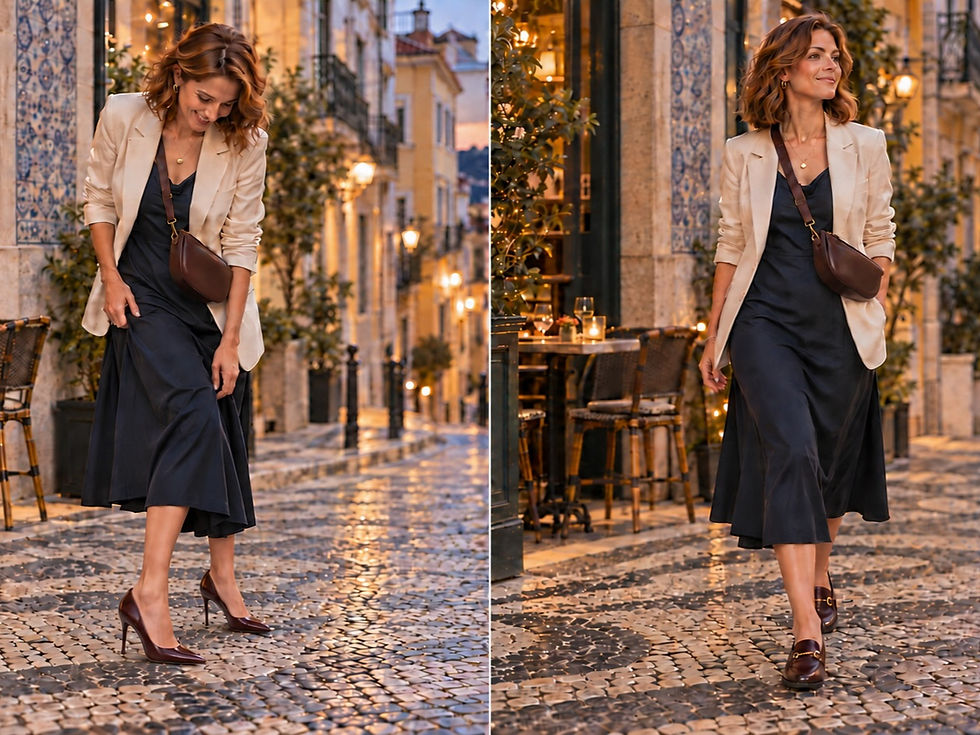
You do not need heels to look elegant in Europe. In fact, flat shoes are often the more sensible choice for cobblestones, hills, train stations, and long days on foot.
I learned this lesson one evening in Lisbon when I decided to wear thin heels for a night out. One heel wedged between the stones of the calçada, and I could not pull it free because I was laughing so hard. Since then, I have chosen comfortable, stable shoes for European cities, even at night.
The secret is choosing footwear that feels intentional and balancing it with your outfit proportions.
Which Comfortable Walking Shoes Work in Europe Without Looking Athletic?
Loafers with cushioned soles, supportive ballet flats, low ankle boots, structured sandals, and low-profile lifestyle sneakers are polished alternatives to technical running shoes. Prioritize support, grip, and a secure fit, especially for cobblestones and long walking days.
Loafers are one of the easiest ways to make a comfortable outfit look polished. Wear them with tailored trousers, straight jeans, or a midi skirt. A cushioned sole and secure fit matter if you plan to walk for several hours.
Supportive ballet flats work well with ankle-length trousers, dresses, and skirts. Look for a structured sole rather than the thinnest foldable styles, which offer little protection on uneven streets.
Flat or low slingbacks are a lovely option for lunch, shopping, or dinner. Make sure the back strap stays securely in place. They may not be the best choice for an entire day on cobblestones.
Low ankle boots suit fall, winter, and rainy spring days. A sleek shape feels more refined than a heavy hiking boot, while a rubber sole provides better grip.
Riding boots look elegant with knit dresses, midi skirts, and slim or straight trousers. They are super useful in colder weather because they provide coverage without requiring a heel.
Structured flat sandals are more versatile in European cities than beach flip-flops. Choose secure straps, a supportive footbed, and a design that works with both daytime and evening outfits.
Minimal lifestyle sneakers are ideal for your longest walking days. Leather, suede, or restrained color combinations usually transition more easily from sightseeing to a café or casual dinner than brightly colored technical running shoes.
For polished shoes that can move from sightseeing to dinner, explore Cole Haan loafers, flats, and ankle boots. If you would rather compare several brands and price points, browse Bloomingdale’s selection of comfortable women’s shoes.
Pay Attention to Proportions
Flat shoes change the outfit visual line, so trouser length matters.
Wide-leg trousers should nearly skim the top of the shoe without touching the ground. Straight and cropped trousers look especially polished with loafers, ballet flats, or slim sneakers.
With ankle boots, avoid excess fabric bunching around the top of the boot.
Dresses and skirts also work beautifully with flat shoes.
A midi dress paired with leather sneakers feels relaxed but intentional.
In cooler weather, add tights and riding boots.
If the outfit feels too loose, create definition with a belt, a shorter jacket, or a neatly tucked top.
What Makes a Dress Travel-Friendly?
A travel-friendly dress should work with flat shoes, allow comfortable movement, and adapt to more than one occasion. Midi lengths are particularly versatile for European cities because they pair easily with sneakers, loafers, sandals, ankle boots, and light jackets.
Look for breathable, opaque fabrics that do not require constant adjustment. Linen blends, cotton poplin, washable jersey, and fine-knit dresses are practical choices. The best option is one you can wear for sightseeing, lunch, and a casual dinner without feeling restricted.
Six Easy Outfit Formulas Without Heels
These six formulas focus specifically on polished looks that work all day in flat shoes.
Outfit formula | Why it works | Best for |
Tailored trousers + fine knit + loafers | Comfortable, simple, and polished | Museums, lunch, and city walks |
Straight jeans + structured jacket + ankle boots | The jacket elevates the denim | Fall and rainy days |
Midi dress + leather sneakers | Feminine without sacrificing comfort | Sightseeing and casual dinner |
Wide-leg trousers + fitted top + flat sandals | Balanced proportions keep the look refined | Warm-weather cities |
Knit dress + riding boots | Elegant, warm, and easy to wear | Fall and winter |
Monochromatic outfit + understated sneakers | A consistent color palette makes sneakers feel intentional | Long walking days |
The best travel outfit is one you can wear for several hours without thinking about it. Start with the shoes your day requires, then build a polished outfit around them. Comfort comes first, but it never has to look like an afterthought.
Do Europeans Wear Sneakers?
Yes, Europeans wear sneakers. The old advice that white sneakers or trainers instantly identify someone as a tourist is simply no longer accurate. You will see sneakers throughout Paris, Milan, London, Berlin, Lisbon, and many other European cities.
The real distinction is not European versus American. It is how the sneakers fit the outfit and occasion:
Lifestyle sneakers usually look more polished than gym-specific shoes.
Clean, well-maintained sneakers feel more intentional than visibly neglected pairs.
Simple colors are easier to combine than highly technical designs.
Appropriate timing: Sneakers work beautifully for sightseeing, cafés, and casual restaurants, but may not suit every formal venue.
You can wear leather or suede sneakers with tailored trousers, straight jeans, a midi dress, or even a relaxed suit. Technical running shoes are still the right choice when you need their support. Never sacrifice comfort for blending in.
For long walking days, compare lifestyle sneakers with supportive features. Choose the model for your feet and support needs, not simply because it is fashionable.
For specific brands and models, see our guide to the best sneakers for comfortable and stylish travel.
Dress for the City, Not for “Europe”

Once you have checked the season and weather forecast, consider the rhythm of the city itself. A day in Milan may call for different choices from a rainy afternoon in Amsterdam or a summer walk through Lisbon.
These are useful starting points, not dress codes:
City context | Style direction | What to prioritize |
Paris and Milan | Polished basics and refined footwear | Day-to-evening versatility |
London and Amsterdam | Adaptable layers and weather protection | Rain and changing conditions |
Berlin and Copenhagen | Relaxed silhouettes and modern sneakers | Functionality and understated styling |
Rome and Lisbon | Breathable pieces and structured sandals | Heat, hills and cobblestones |
Vienna, Munich and Zurich | Smart knitwear and tailored separates | Seasonal flexibility |
Madrid and Barcelona | Breathable tailoring, clean sneakers and structured sandals | Heat and day-to-evening versatility |
After many visits to both cities, I have noticed a clear difference between Paris and Lisbon. Parisian street style often feels polished but deliberately understated, creating that famous sense of effortless elegance.
Lisbon generally feels more relaxed and practical, influenced by its warmer climate, steep hills, and casual rhythm. Neither represents a single European style. They simply show how strongly a city shapes the way people dress.
Lisbon’s hills also affect how I plan my day. I once decided to walk uphill instead of taking transportation, only to arrive completely exhausted and feel the effects for the rest of the day. Comfortable shoes matter, but so do a light bag, breathable clothing, and knowing when to save your energy.
Your itinerary matters too. Museums, walking tours, markets, religious sites, and elegant restaurants do not require the same outfit. Use the city as inspiration, then dress for what you will actually be doing that day.
Sandro, Isabel Marant, and Zadig & Voltaire are all brands I buy from, although each interprets Parisian style differently. Sandro feels refined and modern, Isabel Marant is more relaxed and bohemian, while Zadig & Voltaire adds a sharper rock-inspired edge.
What Changes by Season?

When deciding what to wear in Europe, start with the season. From there, adjust for the destination, forecast, and activities planned.
Spring: Choose light layers, loafers or sneakers, and a weather-resistant jacket for cool mornings and sudden rain. See our European spring outfits guide for more seasonal ideas.
Summer: Pack breathable dresses, linen separates, and structured sandals that can handle long walks. Our European summer outfits guide includes complete looks for warmer destinations.
Fall: Bring soft knitwear, ankle boots, a trench or light coat, and richer seasonal colors. If Paris is on your itinerary, see what to wear in Paris in fall.
Winter: Start with thermal layers, then add warm knitwear, refined boots, and outerwear suited to the destination.
Bergen taught me not to trust a beautiful morning. I was so happy to see the sun that I left without a raincoat. By lunchtime, the sky had turned grey, and the rain was back. Since then, I have carried a light waterproof layer whenever the weather looks changeable, no matter how promising it seems at breakfast.
For colder trips, our European winter outfits guide covers fabrics, layering, footwear, and city-specific outfit ideas in greater detail.
For affordable base layers, fine knits, and packable outerwear, explore Uniqlo’s travel-friendly essentials.
Can You Go Directly from Sightseeing to Dinner?

Sometimes, but not after every sightseeing day. Paris is where I find this transition particularly difficult. It is such a walking city that, by late afternoon, my clothes, hair, and makeup rarely look as fresh as they did in the morning. Parisians also tend to dress more elegantly in the evening than people do in many other cities.
If I have an important dinner reservation in Paris, I prefer to return to the hotel for a quick refresh whenever possible. When there is no time, I start with a versatile outfit and rely on a few small adjustments:
Choose one versatile bag: A compact, structured crossbody carries your essentials during the day and still feels appropriate in a restaurant.
Let your outer layer do the work: If the weather calls for a blazer, trench, or refined jacket, it can instantly elevate what you are already wearing.
In Brazil, I rarely see anyone wearing a trench coat, and I have never understood why. It is one of the most versatile pieces for a European city trip. It can handle a light shower, add polish to the clothes you have worn all day, and provide an extra layer when the temperature drops.
Pack one small finishing touch: Earrings, a silk scarf, or lipstick take up almost no space and can refresh your look in seconds.
Take a two-minute pause: Before dinner, tidy your hair, wipe any marks from your shoes, and remove anything you no longer need to carry.
Comfortable clothes do not have to announce that you have spent the day sightseeing. When the outfit already feels intentional, a quick refresh is enough.
A casual dinner rarely requires a complete change. For a formal restaurant or a special evening in Paris, however, returning to the hotel may be the more comfortable and realistic choice.
A well-cut pair of trousers or a versatile jacket can do more for a day-to-evening outfit than several decorative pieces. For an investment option, explore Theory’s tailored trousers and jackets.
How Can You Avoid Looking Distracted While Traveling?
Clothing is only part of what makes someone look like a tourist. The way you carry your belongings, check directions, and move through a busy city can be far more noticeable than your shoes or jacket.
Choose a Bag That Suits the Day
A compact crossbody bag with a secure closure is practical for city sightseeing and easy to keep in front of you on crowded transport. An open tote may look elegant, but it gives you less control over your belongings in busy places.
Backpacks are perfectly appropriate for hiking, family outings, and days when you genuinely need more space. In crowded stations or on public transport, take the backpack off and hold it where you can see it.
Keep your passport, cash, and travel documents out of sight. Avoid opening your wallet or reorganizing valuables in the middle of a busy street.
Pay Attention to How You Move
Checking your phone can make you appear distracted. Review your route before leaving, and if you need directions, move to the side rather than stopping in the middle of the pavement. Walk attentively and look around, even when you are not completely sure where you are going.
A camera (some people still have a real one) is part of the joy of traveling. Use a secure strap, take your photograph, and put the camera away when you are finished instead of carrying it loosely while distracted.
Looking polished cannot prevent theft, and no bag makes you completely secure. Awareness, sensible habits, and attention to your surroundings matter far more than trying to look like a local.
What Should You Wear to Churches and Restaurants in Europe?
Europe does not have one dress code for churches, restaurants, or cultural venues. A neighborhood chapel, the Vatican Museums, a casual Paris café, and a Michelin-starred restaurant may all have very different expectations.
Before visiting an important religious site, check its official website for current clothing rules. Some require covered shoulders or knees, while others simply ask visitors to dress respectfully. A scarf, cardigan, or light layer can provide coverage without taking up much room. Avoid sheer fabric, which may not satisfy the venue’s requirements.
Restaurant expectations also vary. Jeans and clean sneakers may feel perfectly appropriate in a relaxed bistro or trattoria, while a formal dining room may expect more polished clothing. Check the restaurant’s website or reservation confirmation.
Dress for the specific venue rather than following a supposed countrywide rule. A little preparation helps you feel comfortable, show respect, and avoid an inconvenient last-minute change of plans.
Seven Outfit Formulas for European City Travel

While the shoe pairings above solve the heel question, these seven formulas cover full-day scenarios beyond footwear
The best travel outfits are easy to repeat and adapt. Use these formulas as starting points, then adjust the colors, fabrics, and layers to suit your destination.
1. Airport and Train Travel
Relaxed trousers + breathable top + soft cardigan + clean sneakers + secure crossbody
Choose trousers with a comfortable waistband and enough structure to look polished after several hours of travel. A cardigan is easy to remove, while sneakers make connections and station platforms much easier.
2. Warm-Weather Sightseeing
Linen trousers + sleeveless knit or cotton shirt + structured flat sandals + sunglasses
Breathable fabrics help in the heat, but the tailored shape keeps the outfit from feeling like beachwear. Carry a light scarf or shirt if you plan to enter religious sites.
Sunglasses are practical, but they can also make a simple travel outfit feel finished. For distinctive frames without adding another clothing layer, explore Illesteva sunglasses.
3. Rainy City Day
Straight trousers + fine knit + water-resistant trench or waterproof raincoat + water-resistant ankle boots
A lightweight trench works for light rain, while a waterproof raincoat is more reliable in a downpour. Choose boots with a rubber sole for wet pavements and keep trouser hems high enough to avoid dragging on the ground.
4. Museum and Lunch
Tailored trousers + blouse or fine knit + loafers + compact crossbody
Museums often involve more standing and walking than expected. Loafers with a supportive sole keep the outfit comfortable, while the blouse or knit feels polished enough for lunch afterward.
5. Sightseeing to Dinner
Midi dress + light jacket + polished flats + structured crossbody
A simple midi dress works from sightseeing to dinner. Add earrings, a scarf, or lipstick for a quick refresh.
For versatile midi dresses that work with sneakers, flats, or ankle boots, browse Anthropologie’s current dress collection.
6. Cold-Weather City Day
Thermal base + wool knit + tailored trousers + warm coat + low waterproof boots
Thin thermal layers provide warmth without creating unnecessary bulk. Finish with a scarf and gloves that complement the outfit rather than treating them as purely practical extras.
7. Elegant Evening Without Heels
Dark midi dress or jumpsuit + pointed flats or slingbacks + small structured bag + jewelry
A defined silhouette and a refined shoe matter more than heel height. Keep the accessories simple and let one thoughtful detail, such as earrings or a silk scarf, finish the look.
Frequently Asked Questions
Do Europeans wear sneakers?
Yes, Europeans wear sneakers for everyday city life, commuting, and casual social occasions. Clean lifestyle sneakers in leather, suede, or restrained colors usually look more polished than highly technical running shoes, but comfort and proper support should always come first.
Can I wear leggings in Europe?
Yes, you can wear leggings in Europe. They are most natural for flights, exercise, hiking, and casual outings. For city sightseeing, style them with a longer shirt, knit, or structured jacket rather than wearing a complete gym outfit.
Do Europeans wear shorts?
Yes, Europeans wear shorts, especially during warm weather and in Mediterranean destinations. Tailored or simple shorts generally work better in cities than athletic or cargo styles. Some churches and formal venues may require additional coverage, so check before visiting.
How can I look elegant without heels?
To look elegant without heels, choose refined flat shoes and pay attention to proportion. Loafers, supportive ballet flats, slingbacks, ankle boots, and minimal sneakers work well with tailored trousers, dark jeans, midi dresses, and skirts.
What shoes work on European cobblestones?
The best shoes for European cobblestones have supportive soles, reliable grip, and a secure fit. Low ankle boots, cushioned loafers, and supportive lifestyle sneakers are practical options. Avoid thin soles, unstable heels, and any shoes you have not broken in.
What bag should I carry in European cities?
A compact crossbody bag with a secure zipper is one of the most practical choices for European city travel. It keeps your essentials close without looking bulky. A small backpack also works when you need more space, but hold it in front on crowded transport.
What should I wear when visiting churches in Europe?
Dress requirements vary by church and country, so check the venue’s official website. Some religious sites require covered shoulders and knees. Carrying a scarf, cardigan, or light layer gives you additional coverage, but sheer fabric may not satisfy the rules.
Is it bad to look like a tourist?
No, there is nothing wrong with looking like a tourist. You are there to enjoy and discover a new place. The goal is not to impersonate a local, but to dress appropriately, avoid looking visibly unprepared, and remain attentive to your surroundings.
Does European style change by city?
Yes, European style changes by city, season, climate, and occasion. What works during summer in Lisbon may not suit a rainy day in Amsterdam or winter in Copenhagen. Use local context as inspiration while staying true to your style and comfort.
Are Jeans Okay to Wear in Europe?
Yes, jeans are widely worn across Europe. Straight, relaxed, and wide-leg styles are easily combined with knits, shirts, blazers, loafers, and sneakers. Dark denim transitions particularly well into the evening, while light-wash jeans feel natural during spring and summer.
About the author: Mona is the founder and content director of Tripnsense. After living in France and returning to Europe many times, she writes practical travel and style advice grounded in firsthand experience. |
Disclosure: This article contains affiliate links. If you make a purchase through one of them, Tripnsense may earn a commission at no additional cost to you. I personally shop from the brands mentioned in this guide. I selected individual products for their comfort, materials, design, and suitability for European city travel. Outfit imagery styled and generated for illustration purposes |


Comments